Thursday, October 31, 2013

Poetry Assignment: Creating a Chapbook


Poetry: Creation, of an Artefact


Mission I: Choose poem types / locations in Toronto (25XP)
-         You must write at least ten different poems
-         You must use at least five different poem types
-         You must cover all five of the “Ideas for Poems” (one in each of five poems)
-         Each poem must be related to a specific location in Toronto, somehow
  • Record at least five of the poem types you are going to use, and the ten locations in Toronto you will be using; show this to your teacher.


Mission II: Write poems (50XP)                                                                                                                                                                                     
-         Write the first draft of all ten poems
-         Indicate the connection to Toronto that each poem makes
  • Show your teacher all ten rough poems, and briefly explain the Toronto connection.

Mission III: Gather images relating to your poems (75XP)
-         Take at least one picture at each location
-         Collect at least one ‘found item’ from each of the ten locations.  Found items may be, but are not limited to:
o       Maps
o       TTC transfers
o       Menues
o       Pamphlets
  • Show your teacher the visuals you have collected, and explain the connections.


Mission IV: Combine the written with the visual (100XP)
-         Combine your visual images / found items with your poems to fit the size of paper you will be using
-         Determine in which order your poems will be presented inside your text
  • Show your teacher the final page copies you have created, in order

 
Mission V: Create booklets combining all poems (200XP)
-         Bind your text together, in a way fitting with the assignment requirements
-         Make sure you have included at least ten poems
-         Make sure each poem is combined with a visual
-         include a title page and an index page
  • Submit your finished book to your teacher


A Brief Introduction

You will be responsible for the creation of a chapbook (a book of poetry) that includes at least ten different poems.

You must use at least five types of poems.  You will find a list of various poem types to the left.  The remaining five poems can be of whatever type you choose.  You may only use each poem type twice.

Five of the included poems but relate to the ideas for poems, also listed to the side.  One poem must handle each of the five subjects.  The other five poems can be about anything of your choosing.

Each poem must but set – or involve – in some way, Toronto.

Each poem must include at least two poetic devices.  You must use at least six different poetic devices in the chapbook.


Types of Poems
Concrete Poem
Sound Poem
Found Poem
Verse Poem
Narrative Poem
Sonnet
Limerick
Haiku

 Ideas for Poems
Discuss your youth
Discuss your home
Discuss your present
Discuss your history
Discuss your future

 Poetic Devices
Assonance – repetition of vowel sound
Consonance – repetition of consonant sound
Imagery – language that evokes sensory images
Metaphor – comparison of unlike things without using like or as
Simile – comparison of unlike things using like or as
Onomatopoeia – a word that intimates the sound it represents
Symbol – an object or action that means more than its literal meaning
Slant Rhyme – instead of perfect or identical sounds or rhyme, it’s the repetition of near or similar sounds
Repetition – simple repeating of a word, within a sentence or a poetical line
Meter – the regular rhythms of poetic lines created by a sequence of stressed or unstressed syllables


K
T
C
A

At least five poem types are effectively used

All five “ideas for poem” are demonstrated within the chap book

At least two poetic devices are used in each poem

All ten poetic devices can be found within the chapbook


Poetic devices are used effectively to communicate the desired subject matter

Poem types are well suited for the poems subject matter

Poems show a connection to Toronto

Images are well suited for the related poem


poems and images relate to one another

poems are free of unintentional spelling / grammatical errors

poems transition from one to the next in a logical order

poems demonstrate understanding of style, and poetic devices


Chapbook highlights the author’s experiences

Chapbook communicates a strong idea / understanding of the city of Toronto

Chapbook is well bound

All required elements are found within the completed project

/70


/60

/40

/30

Narrative Poems


Once more, I look to Wikipedia to explain to you the wonders of Narrative poetry.


"Narrative poetry is a form of poetry which tells a story, often making use of the voices of a narrator and characters as well; the entire story is usually written in metered verse. The poems that make up this genre may be short or long, and the story it relates to may be complex. It is usually dramatic, with objectives, diverse characters, and meter. Narrative poems include epics, ballads, idylls and lays.

Some narrative poetry takes the form of a novel in verse. An example of this is The Ring and the Book by Robert Browning. In terms of narrative poetry, a romance is a narrative poem that tells a story of chivalry. Examples include the Romance of the Rose or Tennyson's Idylls of the King. Although these examples use medieval and Arthurian materials, romances may also tell stories from classical mythology.

Shorter narrative poems are often similar in style to the short story. Sometimes these short narratives are collected into interrelated groups, as with Chaucer's Canterbury Tales. Some literatures contain prose narratives that include poems and poetic interludes; much Old Irish poetry is contained within prose narratives, and the Old Norse sagas include both incidental poetry and the biographies of poets. An example is "The Cremation of Sam McGee" by Robert Service."


The Highwayman by Alfred Noyes

PART ONE
I
THE wind was a torrent of darkness among the gusty trees,
The moon was a ghostly galleon tossed upon cloudy seas,
The road was a ribbon of moonlight over the purple moor,
And the highwayman came riding—
Riding—riding—
The highwayman came riding, up to the old inn-door.

II
He'd a French cocked-hat on his forehead, a bunch of lace at his chin,
A coat of the claret velvet, and breeches of brown doe-skin;
They fitted with never a wrinkle: his boots were up to the thigh!
And he rode with a jewelled twinkle,
His pistol butts a-twinkle,
His rapier hilt a-twinkle, under the jewelled sky.

III
Over the cobbles he clattered and clashed in the dark inn-yard,
And he tapped with his whip on the shutters, but all was locked and barred;
He whistled a tune to the window, and who should be waiting there
But the landlord's black-eyed daughter,
Bess, the landlord's daughter,
Plaiting a dark red love-knot into her long black hair.

IV
And dark in the dark old inn-yard a stable-wicket creaked
Where Tim the ostler listened; his face was white and peaked;
His eyes were hollows of madness, his hair like mouldy hay,
But he loved the landlord's daughter,
The landlord's red-lipped daughter,
Dumb as a dog he listened, and he heard the robber say—

V
'One kiss, my bonny sweetheart, I'm after a prize to-night,
But I shall be back with the yellow gold before the morning light;
Yet, if they press me sharply, and harry me through the day,
Then look for me by moonlight,
Watch for me by moonlight,
I'll come to thee by moonlight, though hell should bar the way.'

VI
He rose upright in the stirrups; he scarce could reach her hand,
But she loosened her hair i' the casement! His face burnt like a brand
As the black cascade of perfume came tumbling over his breast;
And he kissed its waves in the moonlight,
(Oh, sweet, black waves in the moonlight!)
Then he tugged at his rein in the moonliglt, and galloped away to the West.


PART TWO

I
He did not come in the dawning; he did not come at noon;
And out o' the tawny sunset, before the rise o' the moon,
When the road was a gypsy's ribbon, looping the purple moor,
A red-coat troop came marching—
Marching—marching—
King George's men came matching, up to the old inn-door.

II
They said no word to the landlord, they drank his ale instead,
But they gagged his daughter and bound her to the foot of her narrow bed;
Two of them knelt at her casement, with muskets at their side!
There was death at every window;
And hell at one dark window;
For Bess could see, through her casement, the road that he would ride.


III
They had tied her up to attention, with many a sniggering jest;
They had bound a musket beside her, with the barrel beneath her breast!
'Now, keep good watch!' and they kissed her.
She heard the dead man say—
Look for me by moonlight;
Watch for me by moonlight;
I'll come to thee by moonlight, though hell should bar the way!

IV
She twisted her hands behind her; but all the knots held good!
She writhed her hands till her fingers were wet with sweat or blood!
They stretched and strained in the darkness, and the hours crawled by like years,
Till, now, on the stroke of midnight,
Cold, on the stroke of midnight,
The tip of one finger touched it! The trigger at least was hers!

V
The tip of one finger touched it; she strove no more for the rest!
Up, she stood up to attention, with the barrel beneath her breast,
She would not risk their hearing; she would not strive again;
For the road lay bare in the moonlight;
Blank and bare in the moonlight;
And the blood of her veins in the moonlight throbbed to her love's refrain .

VI
Tlot-tlot; tlot-tlot! Had they heard it? The horse-hoofs ringing clear;
Tlot-tlot, tlot-tlot, in the distance? Were they deaf that they did not hear?
Down the ribbon of moonlight, over the brow of the hill,
The highwayman came riding,
Riding, riding!
The red-coats looked to their priming! She stood up, straight and still!

VII
Tlot-tlot, in the frosty silence! Tlot-tlot, in the echoing night!
Nearer he came and nearer! Her face was like a light!
Her eyes grew wide for a moment; she drew one last deep breath,
Then her finger moved in the moonlight,
Her musket shattered the moonlight,
Shattered her breast in the moonlight and warned him—with her death.

VIII
He turned; he spurred to the West; he did not know who stood
Bowed, with her head o'er the musket, drenched with her own red blood!
Not till the dawn he heard it, his face grew grey to hear
How Bess, the landlord's daughter,
The landlord's black-eyed daughter,
Had watched for her love in the moonlight, and died in the darkness there.

IX
Back, he spurred like a madman, shrieking a curse to the sky,
With the white road smoking behind him and his rapier brandished high!
Blood-red were his spurs i' the golden noon; wine-red was his velvet coat,
When they shot him down on the highway,
Down like a dog on the highway,
And he lay in his blood on the highway, with the bunch of lace at his throat.

X
And still of a winter's night, they say, when the wind is in the trees,
When the moon is a ghostly galleon tossed upon cloudy seas,
When the road is a ribbon of moonlight over the purple moor,
A highwayman comes riding—
Riding—riding—
A highwayman comes riding, up to the old inn-door.

XI
Over the cobbles he clatters and clangs in the dark inn-yard;
He taps with his whip on the shutters, but all is locked and barred;
He whistles a tune to the window, and who should be waiting there
But the landlord's black-eyed daughter,
Bess, the landlord's daughter,
Plaiting a dark red love-knot into her long black hair.


Fun Activity!
Below is a picture of a squid, fighting a whale, fighting a T-Rex!  Write a narrative poem about it!


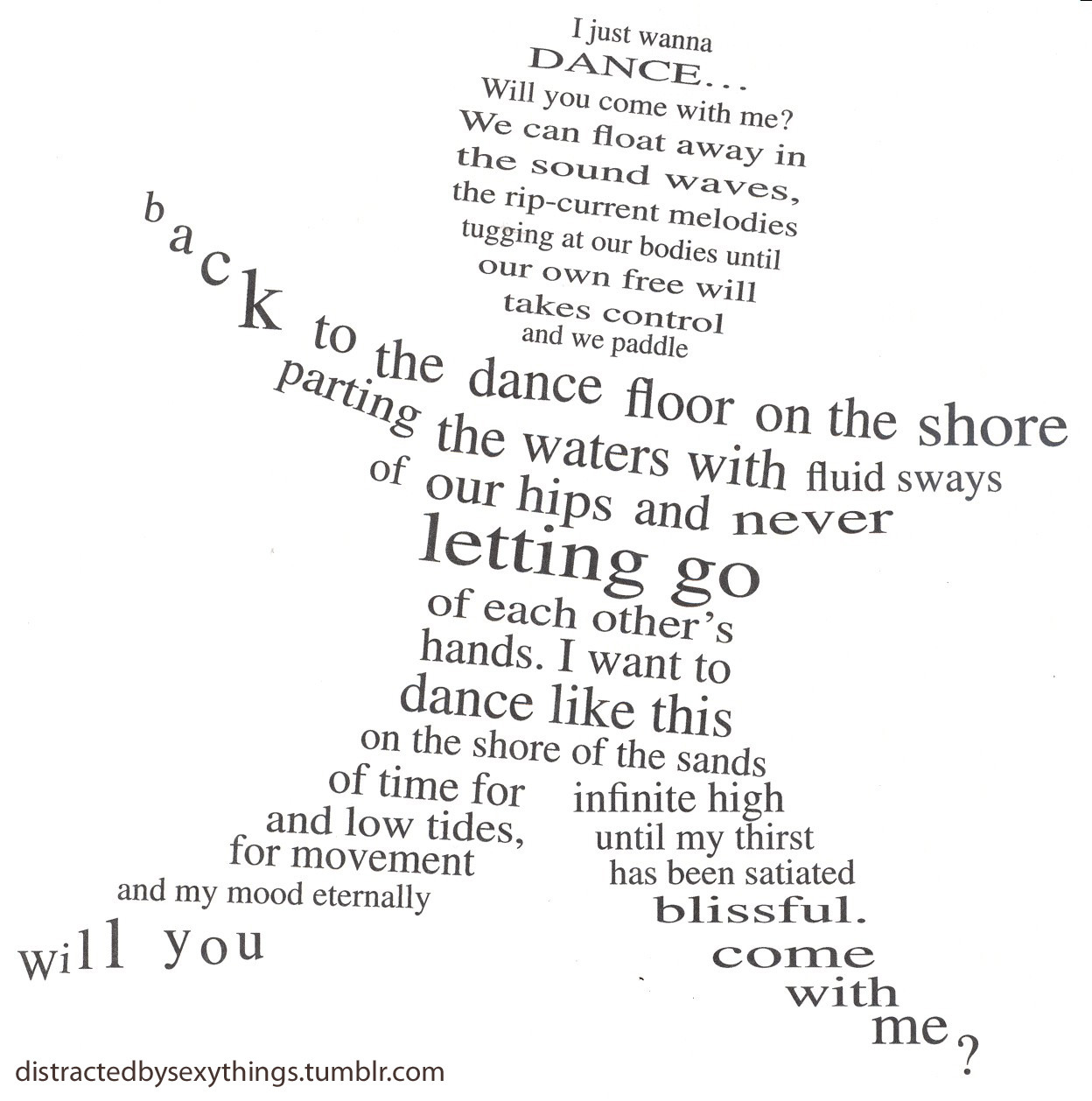
Concrete Poems


Concrete poetry is a form of poetry where the shape of the poem carries just as much meaning as the words.  There are times when the formatting of the text will be in such a way as to communicate a message to the audience.  There are a number of ways in which this can play out.

Below is an example of how to create a concrete poem.  Using a “fixed-width” font, the image was blocked out with Xs.  In the first example, we see a “Sound Poem” being used to communicate an idea about the game / arcade culture of the 80s. 

In the second example, text is used – clarified by placing a “/” between each word, to help the reader better understand what they are processing. 


      XXX               XXX
      XXX               XXX
         XXX         XXX
         XXX         XXX
      XXXXXXXXXXXXXXXXXXXXX
      XXXXXXXXXXXXXXXXXXXXX
   XXXXXX   XXXXXXXXX   XXXXXX
   XXXXXX   XXXXXXXXX   XXXXXX
XXXXXXXXXXXXXXXXXXXXXXXXXXXXXXXXX
XXX   XXXXXXXXXXXXXXXXXXXXX   XXX
XXX   XXX               XXX   XXX
         XXXXXX   XXXXXX
         XXXXXX   XXXXXX

    
      BLE               EPB
      LOO               PBL
         EEP         BLE
         EPB         LOO
      PZOOOOOOOORPBLEEPBLOO
      PBLIPBLIPBLIPBLIPBLOR
   GBLEEP   SPACEBLIP   BLEEPB
   LIPBLI   PINVADERS   BLOORP
BLIPBLIPBLIPBLIPBLIPBLIPBLIPZOORM
BLEEPBLEEPBLEEPBLIPBLIPBLIPBLIPBL
EEP   SPACEBLEEPBLEEPBLIPBL   OOP
BLE   EPBLIPBLIPINVADERSBLE   EEP
ZOO   ORM               BLI   PBL
IPB   LIP               BLO   ORM
         SPACEB   LEEPBL
         EEPINV   ADERS!


IN/               SPA
CE/               THE
Y/S         AY/
NO/         ONE
/CAN/HEAR/YOU/SCREAM.
ROW/BY/ROW/THEY/CAME/
REVERB   ERATING/T   HROUGH
/THE/G   ALAXY,IN/   A/SWAR
M/UNHEARD/OF.FIRST/THEY/CAME/IN/D
ARKNESS,HIDDEN/AMONGST/THE/UNCARE
D/F   OR/YOUTHS/WHOSE/MINDS   /WE
RE/   FILLED/WITH/THE/DRONE   /OF
MIS   BEG               OTT   EN.
WHE   N/T               HEY   /MA
DE/THE   IR/PRE
SENCE/   KNOWN/


IT/
WAS
/TO
O/L
ATE


Concrete Poems: Further Examples

Concrete Poems do not need to be overly complex.  Please refer to the examples below:  Many line the ones below can be discovered around the interconnected network of computers, and tubes, that many of us call: the interwebs!


Wednesday, October 23, 2013

Found Poetry

Found poetry is a form where you (and these are my words here) take stuff, and make other stuff with it. This, though, probably is not helpful for you. So, in lieu of wanting to help you, I’m going to copy and paste the Wikipedia definition. It’s better than mine: Found Poetry is a type of poetry created by taking words, phrases, and sometimes whole passages from other sources and reframing them as poetry by making changes in spacing and lines, or by adding or deleting text, thus imparting new meaning.


Tuesday, October 22, 2013

Rhyming Poems


Some poems use rhyme schemes for a multitude of reasons.  In some cases they may elevate the poem above the ‘lower class.’  Others use rhymes in order to help in remembering the poem.  This was often the case with epic oral narratives, such Homer’s Odyssey.  Still others used rhymes to invoke a sense of magic that word play can create in the mind of the reader.  Remember, a rhyme scheme can be expressed through letters.  Three examples are below.


AABBA – Limericks
ABABCDCDEFEFGG – Sonnet
ABABACCA – One Ring


Limerick
A Cold Woman

By Paul McCann


A -
There once was a woman of ice.
A - She never knew how to be nice. 
B - She spent all of her life,               
B - on the edge of a knife,                
A - cutting herself off from advice.     
Sonnet

A - Shall I compare thee to a summer's day?             
B - Thou art more lovely and more temperate. 
A - Rough winds do shake the darling buds of May, 
B - And summer's lease hath all too short a date. 
C - Sometime too hot the eye of heaven shines,  
D - And often is his gold complexion dimmed;                    
C - And every fair from fair sometime declines,                  
D - By chance, or nature's changing course, untrimmed; 
E - But thy eternal summer shall not fade,                                          
F - Nor lose possession of that fair thou ow'st,                                
E - Nor shall death brag thou wand'rest in his shade,                       
F - When in eternal lines to Time thou grow'st.                 
G -      So long as men can breathe, or eyes can see,                       
G -      So long lives this, and this gives life to thee.                           


One Ring
A -
Three Rings
for the Elven-kings under the sky,            
B - Seven for the Dwarf-lords in their halls of stone,       
A - Nine for Mortal Men doomed to die,                       
B - One for the Dark Lord on his dark throne              
A - In the Land of Mordor where the Shadows lie.       
C - One Ring to rule them all, One Ring to find them,  
C - One Ring to bring them all and in the darkness bind them
A - In the Land of Mordor where the Shadows lie.       


Assignment
Write 2 Limericks about people you know (friends / family)

Write 1 Sonnet about anything you want.

Friday, October 18, 2013

Expanding to Freeverse


What is a Free-Verse Poem?
A free verse poem is just a bunch of line spaces.  There could be more to it, but there doesn’t have to be.  Just take any text, break up the lines so they look funky, and you have yourself a free verse poem.  Some people might tell you there’s more to it, but that’s just because they’re jealous.

Example:
A free verse poem
is just a bunch of line spaces. 
There could be
more to it,
but there doesn’t have
            to
                        be. 

Just take any text,
                        break up
            the lines
                        so they look
funky,
and you have yourself a
            free verse poem. 

Some people might tell you
there’s more to it,
but that’s just
because they’re
jealous.
 From Haiku to Freeverse:
First take a look at your Haiku...

            By the Southern Shore,
            towering above the clouds,
            blocked by urban sprawl

Think about what really matters there, and touch on those ideas.  Describe them to their fullest.  Paint a picture of what you see in your mind, when you think o that object, and force that picture into the mind of your readers.


Southern Shore
Towering above the clouds
the southern sentinel
guards the harbour
sending off feelings of goodwill
            and spirit
to all those passing beneath its
nocturnal luminescence.

Cascading lights travel high
before falling back to earth
where neck-strained tourists gaze upon
a tower created by a company
long forgotten.

Canadian, and National -
Once helicopters dropped the final pieces
slowly into place.

Now it is the X marking the spot
for those on route
to enjoy the summer past time.

Visible to all who live, wrapped in the luxury
of high priced, condo living.

Blocked to those
standing lonely
in the West.


Note:
The poem still talks about the C.N. tower - it’s just a bit longer.  There’s a bit more description going on.  The idea is to take what you know and what you feel and put it out there for others to appreciate.


Assignment:
Take one (1) of your Haikus and convert it into a Free-Verse poem.